Quantacraft Marine
Flux HV configured build

What It Does
A protected high-voltage charging bridge.
Flux HV takes auxiliary 12V battery capacity and converts it into a reviewed high-voltage charging output for compatible kayak motor battery systems. Output is adjustable from 40V to 60V through Bluetooth and the VictronConnect app. It is designed for anglers who already carry useful onboard energy and want a protected way to use it for backup, recovery, or solar-assisted charging.
- Converts auxiliary 12V battery capacity into a high-voltage charging output
- Adjusts output from 40V to 60V through Bluetooth and the VictronConnect app
- Connects through the charging pathway, not by modifying internal battery electronics
- Supports range extension, emergency recovery, and solar-assisted charging
- Helps anglers get more utility from existing onboard energy systems
- Configured around the user's battery, motor, charge port, and connectors
Torqeedo Users
Another option for proprietary battery systems.
Torqeedo built one of the earliest serious kayak propulsion ecosystems, but many legacy users are now stuck between expensive proprietary spare batteries and the cost of switching platforms. Flux HV is designed to give those users another option: use an auxiliary battery system to support the Torqeedo pack through its charging interface.
The goal is not to open the battery, bypass safety electronics, or hack the pack. The goal is to use the existing charging pathway after the motor, battery, charger input, connector, and use case have been reviewed.
Newport + Generic 36V / 48V Systems
Useful when you already have onboard energy to repurpose.
Flux HV can also support reviewed 36V and 48V battery systems, but the value proposition is different. If you simply need more capacity and do not already carry a 12V battery, a second dedicated propulsion battery may be the better choice.
Flux HV makes more sense when you already have 12V capacity onboard and want to use it as backup or supplemental charging.
Example Configuration
12V to 36V Newport support.
This Flux HV build was assembled around a 36V Newport-style electric kayak setup. It uses a 12V auxiliary battery source and converts that power into higher-voltage charging support for a 36V trolling motor battery system.
Example shown
13.5V input / 43.5V output
Displayed in VictronConnect. Output voltage, charge behavior, and supported configurations depend on battery system, charger settings, thermal conditions, connectors, and final configuration.
Feature Callouts
Product photos and system details.

Live System Monitoring
13.5V in / 43.5V out shown in VictronConnect
12V Input Source
50Ah LiFePO4 battery used in the example setup
Protected 12V Input
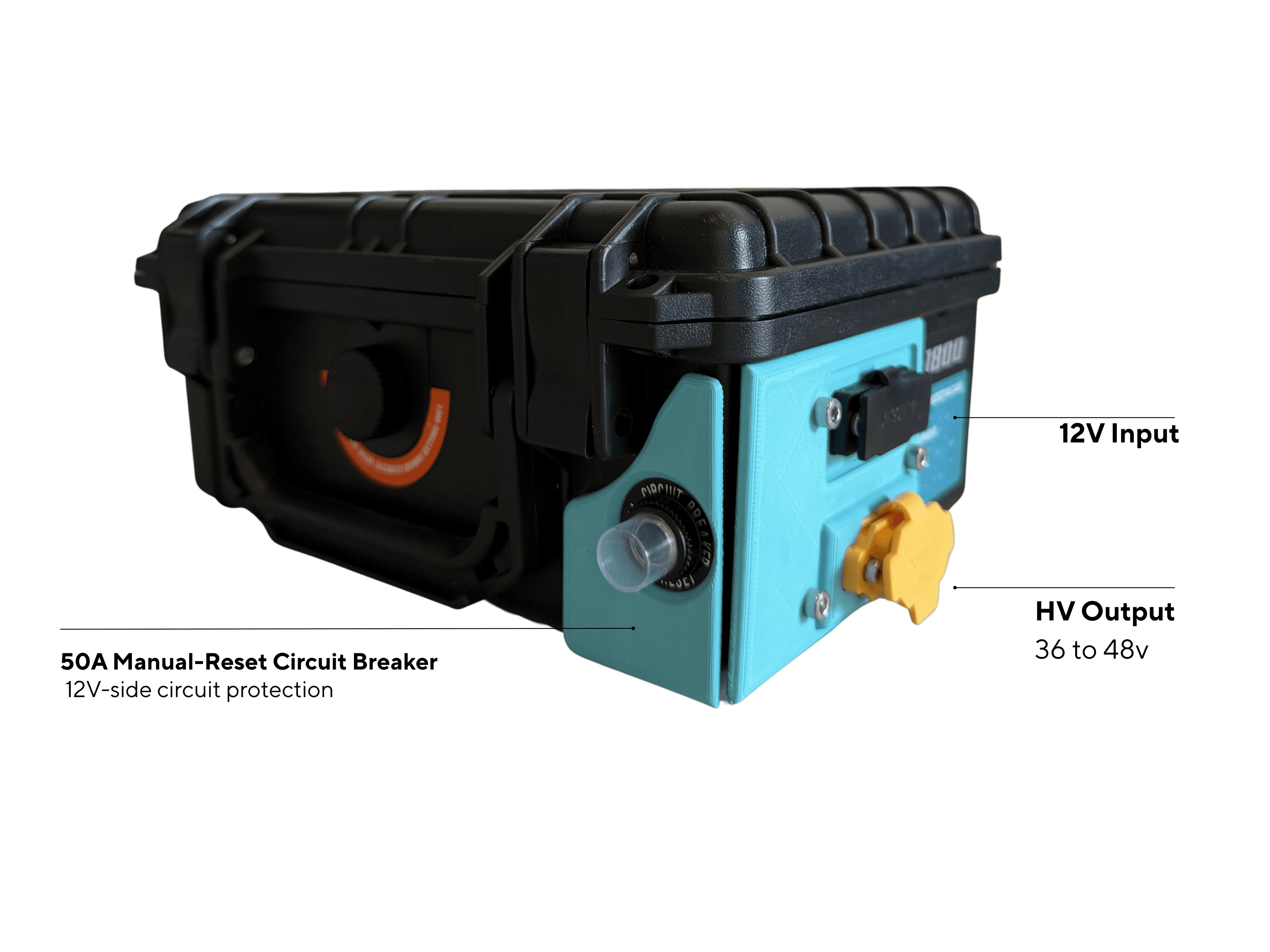
50A manual-reset breaker, configuration dependent
Flux HV Conversion Unit
12V input -> adjustable 40V-60V charging output
Victron Energy 12/48 Isolated DC-DC Charger
Off-the-shelf charger hardware adjusted through Bluetooth and VictronConnect
12V Input Cable
XT90 to ring terminals in the shown example
HV Output Cable
Configured for the target battery system
Use Cases
Where Flux HV makes the most sense.
Torqeedo Range Extension
Use reviewed auxiliary battery capacity to support expensive proprietary packs through the charging interface.
Tournament Backup Charging
Add a reviewed backup path for long days, current, wind, distance, and unexpected power use.
Solar-Assisted Kayak Charging
Use a solar-backed house battery or electronics battery as part of a reviewed supplemental charging setup.
Emergency Return-to-Ramp Reserve
Keep onboard energy available as a recovery option when the day runs longer than planned.
Repurpose Existing LiFePO4 Capacity
Put a 12V house or electronics battery to work instead of carrying disconnected battery systems.
Protected Power Path
Manual-reset circuit protection, purpose-built cabling, and setup review before use.
Designed For
Electric kayak and small-craft users carrying useful 12V power.
What Flux HV Is Not
Not a replacement for battery planning.
- Not a replacement for every 36V battery
- Not a motor controller
- Not a battery hack
- Not intended to bypass battery management systems
- Not guaranteed to fit every charger port without validation
- Not always the most economical choice for open 36V systems
Flux HV is a supplemental charging and energy-transfer system for users who want a reviewed way to use onboard energy they already carry.
Before You Request One
Flux HV is most likely to make sense if one of these is true.
- I have a Torqeedo or proprietary high-voltage battery system
- I already carry a 12V LiFePO4 battery onboard
- I want backup or emergency charging, not a primary battery replacement
- I have solar or house power I want to put to work
- I want to extend an existing system before switching platforms
What's Included
A configured build, cables, review, and support.
Base package
- Flux HV configured conversion unit
- Rugged portable enclosure
- Internal isolated DC-DC charger
- 12V input cable
- HV output cable configured to customer setup
- Manual-reset input protection
- Basic user guide and safety sheet
- Configuration review
- Early user support
Optional / quoted
- Custom output connector
- Additional cable sets
- Different battery voltage configuration
- Mounting / storage accessories
- Solar or 12V source integration guidance
- Custom case labeling
Core Specifications
Reviewed and configured before use.
Product
Flux HV
Input
Reviewed 12V auxiliary DC source, configuration dependent
Output configurations
40V-60V adjustable output for reviewed Torqeedo, 36V, and 48V battery setups
Output current
Up to 8A depending on configuration and conditions
Example 36V charge target
Approximately 43.8V for compatible 36V LiFePO4 systems, configuration dependent
Internal conversion hardware
Configuration-dependent DC-DC converter / charger module
Monitoring and adjustment
Bluetooth adjustment through the VictronConnect app
Input protection
50A manual-reset breaker, configuration dependent
Enclosure
Rugged portable case
Use case
Supplemental charging / energy transfer
Status
Configured early-access build
Output voltage and current depend on battery chemistry, charger settings, thermal conditions, wiring, connectors, and final configuration.
Compatibility must be reviewed before use.
Flux HV is not a universal charger for every battery system.
Hardware Attribution
Current early-access Flux HV builds may use off-the-shelf Victron Energy charging hardware depending on configuration. Future configurations may use different qualified conversion hardware after validation. Quantacraft Marine does not claim ownership of Victron Energy products, VictronConnect, or their underlying applications. Quantacraft's work is the small-craft package around that hardware: enclosure layout, cabling, protection, configuration, documentation, and user support.
Victron Energy and VictronConnect are the property of their respective owner. Quantacraft Marine is not affiliated with, sponsored by, or endorsed by Victron Energy.
Pricing
Starting at $525.
Flux HV is currently priced as a configured early-access build. Final pricing depends on voltage configuration, cable requirements, connectors, protection, testing, and support needs.
Base Flux HV configured unit
Starting at $525
Custom connector/cable changes
Quoted as needed
Additional cable set
Quoted as needed
Custom case/panel configuration
Quoted as needed
Request Configuration
Tell us your setup.
Small-craft power systems vary widely. Tell us your boat, motor, battery voltage, battery brand, charge port, connectors, and what problem you are trying to solve. Quantacraft Marine will review the setup and recommend a Flux HV configuration if there is a good fit. Helpful details include your motor system, battery voltage, battery capacity, current charging setup, whether you already carry 12V onboard power, and the runtime problem you are trying to solve.
Current Status
Early field testing before broader availability.
Flux HV is currently in early field testing with experienced kayak anglers. The first test units are being evaluated on real fishing setups before broader availability.
Compatibility depends on the motor, battery, charger input, connector, and battery management system. Contact Quantacraft before connecting Flux HV to a new setup.